Infographic Databases 01:
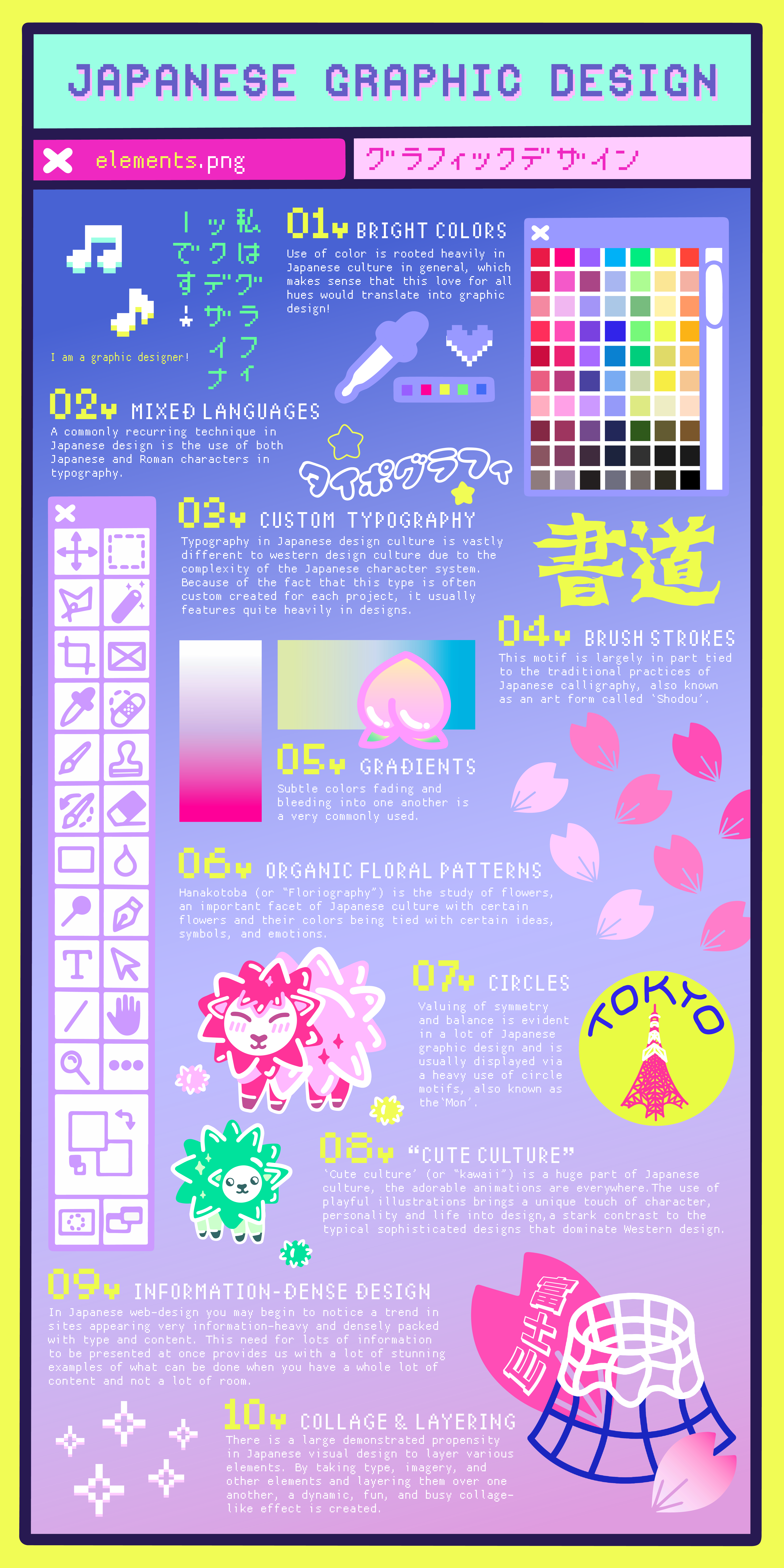
Goal discription: Elements Japanese Graphic Design
| # | Name: label for each section/step | Qualitative information: Features, important message or description for each parts, step or section | Quantitative information: relationship, facts, data, number for for each parts, step or section | How to visualize Qualitative information | How to visualize quantitative information |
|---|---|---|---|---|---|
| 01 | Bright Colors | Use of color is rooted very heavily in Japanese culture in general, which makes sense that this love for all hues would translate to graphic design. | When you’re building a color palette and feel pressured to only use 2-3 colors, why not consider breaking that ‘rule’ and using a more diverse palette and see what it can do for you and your design. | Colorful illustration | Rule break with color |
| 02 | Mixed Languages | A commonly recurring technique in Japanese design is the use of both Japanese and Roman characters in typography. | The contrast between the two languages makes for an intriguing comparison of the two cultures and a highly engaging typographical design. | Japanese and English typography | Typographic characters |
| 03 | Custom Typography | Typography in Japanese design culture is vastly different to western design culture due to the complexity of the Japanese character system | Because of the fact that this type is often custom created for each project, it usually features quite heavily in designs. | Hiragana alphabet | Varied type styles |
| 04 | Brush Strokes | This motif is largely in part tied to the traditional practises of Japanese calligraphy, also known as an art form called ‘Shodou’. | Shodou art, the brushstrokes are often messier, streaky, and cruder, as the art form dictates that no corrections to each stroke should be made, instead each line should simply flow into the next. | “Shodou” | Messy, streaky, cruder strokes |
| 05 | Gradients | Subtle colours fading and bleeding into one another is a very commonly used graphic element. | Used for backgrounds to bring life and color to designs. | Gradient on object | Gradient background |
| 06 | Organic Floral Patterns | Hanakotoba (or “Floriography”) is the study of flowers, an important facet of Japanese culture. | Certain flowers and their colors are tied with certain ideas, symbols, and emotions. We see a lot of flowers and floral patterns being used in Japanese graphic design, both in a symbolic capacity as well as a decorative one. | Sakura print | pink=curing of diseases red=passionate love white= virtue |
| 07 | Circles | Inherent symbols of balance and harmony, circles are widely used motifs in Japanese design. | Valuing of symmetry and balance is evident in a lot of Japanese graphic design and is usually displayed via a heavy use of circle motifs. | "Mon" | Just as the Japanese flag hints |
| 08 | “Cute Culture” | ‘Cute culture’ (or “kawaii”) is a huge part of Japanese culture, the adorable animations are everywhere. | The use of playful illustrations brings a unique touch of character, personality and life into design, a very different interpretation to the typical sophisticated designs that dominate Western design. | Television shows/ merchandise/ professional branding | Kawaii mascot |
| 09 | Information- dense Design | In Japanese web-design you may begin to notice a trend in sites appearing very information-heavy and densely packed with type and content. | This propensity and generalized need for lots of information to be presented at once provides us with a lot of stunning examples of what can be done when you have a whole lot of content and not a lot of room. | Promotion with lots of text | Informational poster |
| 10 | Collage and Layering | There is a large demonstrated propensity in Japanese visual design to layer elements, producing a collage-like effect. | By taking type, imagery, and other elements and layering them over one another, a dynamic, fun, and busy collage-like effect is created. | Layering | Experimental beautiful mess |
Infographic Databases 02:
Goal discription: Sub-culture: Yami-Kawaii
| # | Name: label for each section/step | Qualitative information: Features, important message or description for each parts, step or section | Quantitative information: relationship, facts, data, number for for each parts, step or section | How to visualize Qualitative information | How to visualize quantitative information |
|---|---|---|---|---|---|
| 01 | Rising suicide rate linked to COVID-19 | Mental health and suicide are still largely considered taboo subjects in Japanese culture, "yami kawaii" fashion is the perfect way for people struggling to express themselves. | According to the National Police Agency, there were 1,854 suicides across the country in August of 2020, up 16% from the same month one year ago. The number of female suicides was up more than 40%. | Yami-Kawaii | Suicide awareness |
| 02 | Communicating through fashion | "Yami kawaii" can be traced back to a manga series by author Ezaki Bisuko featuring a girl named Menhera-chan. | His protagonist wears a cute pink school uniform and has pigtails, but teams up with two like-minded friends in a group called the Wrist Cut Warriors. The manga subsequently spawned similar tales of woe and accompanying fashion brands, such as Amilige, Jamie Ank and Listen Flavor. | Menhera-chan | Fashion brand logos |
| 03 | 'Safe and playful' way to share experiences | Anything that can help an individual "make sense" of their feelings and to externalize those emotions is a positive thing. | Through fashion, jewelry or makeup choices, iit helps them not to feel ashamed of themselves. | Positive cross icon | Fashion, Jewelry, Makeup |
Choose one database from these two to start the infographic details
Magazine Homepage design XD file link
Magazine XD file link